


Every individual constructs their morality through a personal blend of lived experience and psychological disposition. As psychologist Lawrence Kohlberg outlined in his theory of moral development, human moral reasoning evolves over time—moving from a self-serving attempt to avoid punishment (pre-conventional), to maintaining social order and tradition (conventional), and finally to evaluating abstract ethical principles like justice, human rights, and systemic fairness (post-conventional).
However, morality does not develop in an isolated laboratory. An interactionist perspective reminds us that individual values continuously collide with societal structures. Our personal beliefs collectively form the consensus that defines society’s moral baseline—the “standard.”
The fundamental question becomes: Is that standard set once and etched in stone? What happens when a new generation, forged in an entirely different reality, develops values that clash with the old consensus?
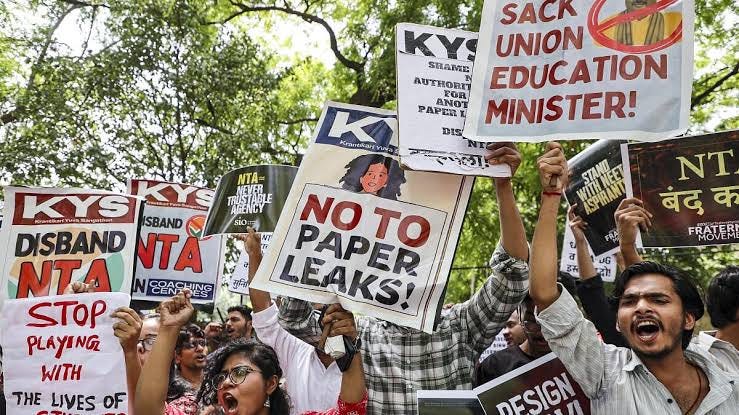
The recent National Eligibility cum Entrance Test (NEET) paper leak protests in India serve as a case study for this exact rupture. It was not merely an administrative failure; it was a bare-naked breakdown of a value system, revealing how vulnerable we are to change, and how deeply past scars dictate our present.
I. The Scarcity Mindset: Why We Built a Predictable Algorithm
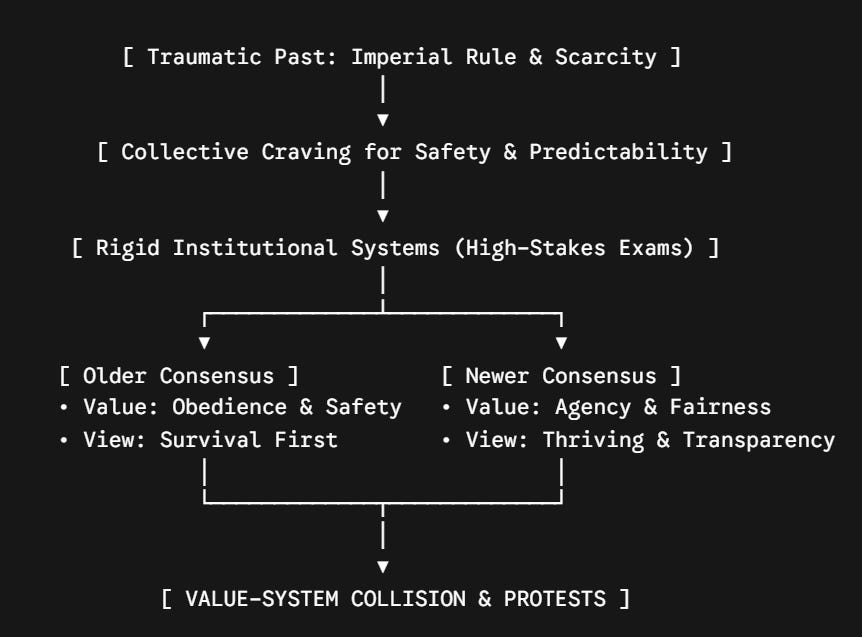
Post-independence India inherited a fractured landscape. Emerging from nearly two centuries of systemic extraction under the British Empire, alongside the trauma of Partition and severe national famines, the country naturally built a culture centered on predictability and safety. When resources are scarce and survival is threatened, human societies crave rigid structure.
This historic trauma engineered an unwritten social contract:
The “Safe” Path: Opting for Science or Mathematics in 11th and 12th grades was rarely about pure passion or self-actualization. It was treated as a predictable algorithm for economic survival.
Exams as Status Quo: National competitive exams ceased to be mere academic evaluations. They became hyper-competitive societal status symbols, wrapped in an ultimatum: succeed or slip into uncertainty.
Nearing a century of freedom, an aspirational nation is still clinging to patterns of familiarity born out of an old crisis. The historical grounding for this panic is fading, yet youth are still forced to navigate a high-stakes rat race just to secure basic stability.
II. Systemic Inertia ,“Naughty Children," and the NTA Crisis
Enter the National Testing Agency (NTA). For years, students have endured redundant, bureaucratic, and highly stressful exam administration processes. When paper leaks and grace-mark controversies erupted, the establishment relied on familiar rationalizations: millions of candidates, limited infrastructure, administrative burden.
This logic rests on two major psychological and sociological phenomena:
Dismissal as "Stubborn Tantrums": The establishment framing reduced valid grievances to the behavior of ungrateful, naughty children throwing a tantrum. The narrative shifted to: "We provided you with resources our generation never had; how dare you ask for more?" What the establishment labeled as "stubbornness" was actually a demand for basic institutional integrity.
Realistic Conflict Theory: Friction arises when groups compete for limited resources. In modern India, the scarce resource isn’t just a seat in a medical college—it is predictable stability. When the system fails to deliver that baseline, suppressed agony turns into open conflict.
The Just-World Fallacy: Society often rationalizes institutional flaws by believing the world is inherently fair, telling struggling youth: “You have resources your ancestors didn’t have, stop throwing tantrums.” Dissent is dismissed using defensive rhetoric—labeling protesting students as “uneducated” or “guided by foreign powers.”
Crucially, crises cannot be manufactured from thin air by external enemies; they can only be amplified when an internal structure is already rotting. When citizens are treated not as stakeholders but as subjects, the founding democratic promise—of the people, by the people, for the people—is tossed aside.
III. Survival Is Over: The Intergenerational Value Shift
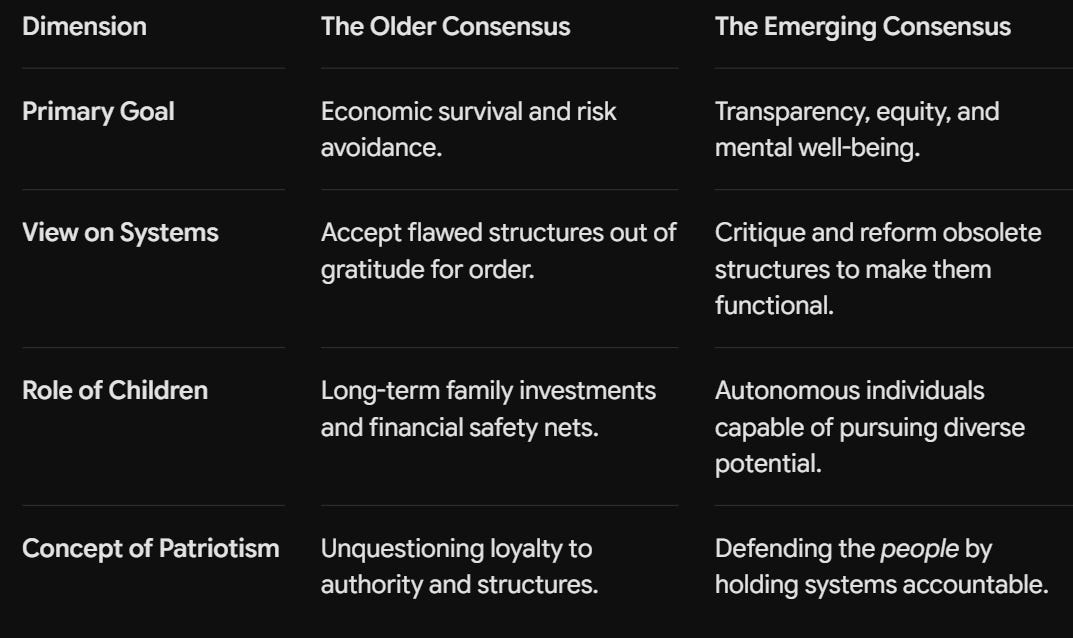
The clash between the state and the protesting students reveals a generational divide in moral development:
Throughout history, Indian youth have united under broad banners to drive progress—from the soldiers of Rani Lakshmibai to the freedom fighters of the 20th century. Demanding systemic accountability is not anti-national; it is deeply patriotic. Changing a broken process does not mean hating what our predecessors built. It means chiseling away the old rot on ancient gold so it can shine again.
IV. Moving From Investment to Empowerment
We live in an age of unprecedented global change, rapid technological acceleration, and evolving career landscapes. Forcing today’s youth to survive on rigid 20th-century scaffolding is a form of sociological suicide—where a society’s internal structures suffocate its own future.
Slacktivism and moral posturing may happen along the margins, but the core energy of these protests comes from a place of residual hope. Apathy is silent; protest means the youth still believe the nation can be better.
It is time to rewrite the intergenerational contract:
Stop rationalizing systemic incompetence under the guise of population or resource limits.
Stop framing student grievances as tantrums, and recognize them as valid calls for structural reform.
Shift from survival mode to thriving mode, recognizing that modern youth require options, equity, and institutional integrity.
Treat children as autonomous individuals to be guided, rather than financial instruments or vessels for ancestral anxieties.
Survival is over. The foundation was built by the past, but the structure belongs to those who have to live inside it. It is natural to adapt, and it is time to let the future breathe.
I can vouch for this firsthand—I was allowed to fail a few times, and because of that grace, I thrive today.
Above all, love your children and trust them with their own fate. Stop treating them as financial safety nets or attempts to replay your past anxieties. You brought them into this world to unlock their own potential, not to carry out a pre-scripted life on your behalf. Your role as a generation is to guide, protect, and then step back—let them live, let them fail, let them rebuild, and let them lead.
References & Conceptual Glossary:
1. Value System Crisis
Definition: A macro-sociological phenomenon that occurs when a society’s established moral baseline, cultural norms, and institutional expectations clash directly with the lived experiences and evolving imperatives of a new generation. This creates a legitimacy crisis where institutional authority is no longer recognized as morally binding by the populace.
Application in Article: Serves as the core diagnostic framework for the NEET protests. The conflict was not merely an administrative glitch; it was a fundamental collision between an older, survivalist consensus (demanding obedience and risk aversion) and an emerging consensus (demanding transparency, individual agency, and systemic fairness).
Reference (APA):
Inglehart, R. (1997). Modernization and Postmodernization: Cultural, Economic, and Political Change in 43 Societies. Princeton University Press.
Parsons, T. (1951). The Social System. Free Press.
2. Kohlberg’s Stages of Moral Development
Definition: A psychological framework developed by Lawrence Kohlberg proposing that moral reasoning progresses through six stages across three levels: Pre-conventional (driven by obedience, self-interest, and punishment avoidance), Conventional (driven by societal rules, interpersonal accord, and maintaining social order), and Post-conventional (driven by social contract, individual rights, and universal ethical principles).
Application in Article: Used to explain the intergenerational value clash. The institutional status quo operates primarily at the Conventional stage (demanding obedience and rule maintenance), whereas the protesting youth demand a Post-conventional standard (demanding equity, systemic justice, and institutional accountability).
Reference (APA):
Kohlberg, L. (1984). The Psychology of Moral Development: The Nature and Validity of Moral Stages. Harper & Row.
3. Interactionist Perspective (Sociology & Psychology)
Definition: A theoretical paradigm asserting that human behavior and internal mental structures are created through continuous interaction between the individual’s agency and their social environment, rather than purely determined by biology or static cultural rules.
Application in Article: Establishes that individual moral beliefs form societal consensus, but that consensus must remain fluid as lived experiences and external environments change over generations.
Reference (APA):
Blumer, H. (1986). Symbolic Interactionism: Perspective and Method. University of California Press.
4. Realistic Group Conflict Theory (RGCT)
Definition: A social psychological theory developed by Muzafer Sherif stating that conflict, prejudice, and discrimination arise between groups when they are in direct competition for limited, scarce resources.
Application in Article: Identifies the core “scarce resource” in modern India not just as medical college seats or degrees, but as predictable life stability and institutional integrity. Competition over this scarcity fuels systemic tension and public protest.
Reference (APA):
Sherif, M. (1966). Group Conflict and Co-operation: Their Social Psychology. Routledge & Kegan Paul.
5. The Just-World Hypothesis (Belief in a Just World)
Definition: A cognitive bias identified by Melvin Lerner where individuals assume that the world is inherently fair, leading them to rationalize systemic injustices by believing victims “deserve” their fate or that suffering is an unavoidable part of a proper order.
Application in Article: Explains why authorities and older generations dismiss student grievances—rationalizing that candidates must endure intense stress, high-stakes panic, and administrative failures as a necessary “rite of passage.”
Reference (APA):
Lerner, M. J. (1980). The Belief in a Just World: A Fundamental Delusion. Plenum Press.
6. Conformity and System Justification Theory
Definition:
Conformity: The act of matching attitudes, beliefs, and behaviors to group norms or authority expectations (Asch, 1951).
System Justification Theory: A socio-psychological theory proposing that individuals possess a motivational drive to defend, bolster, and rationalize existing social, economic, and political structures even when those systems are dysfunctional or unfair (Jost & Banaji, 1994).
Application in Article: Shows how clinging to outdated academic tracks (”taking STEM for safety”) and accepting bureaucratic inertia are products of social conformity and system justification born out of post-colonial survivalism.
References (APA):
Asch, S. E. (1951). Effects of group pressure upon the modification and distortion of judgments. In H. Guetzkow (Ed.), Groups, Leadership and Men (pp. 177–190). Carnegie Press.
Jost, J. T., & Banaji, M. R. (1994). The role of stereotyping in system-justification and the production of false consciousness. British Journal of Social Psychology, 33(1), 1–27. https://doi.org/10.1111/j.2044-8309.1994.tb01008.x
7. Slacktivism and Moral Signaling
Definition:
Slacktivism: Low-effort, low-cost actions performed via social media or online platforms in support of a cause, often serving to boost personal feelings of satisfaction without producing meaningful real-world impact (Cabrera et al., 2017).
Virtue/Moral Signaling: The public expression of moral values or stances primarily intended to demonstrate one’s social alignment, high moral character, or standing within an in-group.
Application in Article: Acknowledges that while superficial online posturing exists during youth movements, it should not obscure the genuine, high-stakes agony and authentic calls for structural reform driving the core protests.
References (APA):
Cabrera, N. L., Matias, C. E., & Montoya, R. (2017). Activism or slacktivism? The reality of social media in contemporary student activism. Journal of Diversity in Higher Education, 10(4), 400–415. https://doi.org/10.1037/dhe0000028
Tosi, J., & Warmke, B. (2020). Grandstanding: The Use and Abuse of Moral Talk. Oxford University Press.
8. Sociological Anomie & Structural Strain Theory
Definition: Formulated by Émile Durkheim and expanded by Robert K. Merton, Anomie refers to a state of normlessness where social structures break down, creating a disconnect between cultural goals (e.g., success, stability) and institutional means (e.g., fair, accessible exams).
Application in Article: Framing the NEET crisis as a structural strain—students are told to pursue the cultural goal of success, but the institutional mechanism (NTA/exam systems) is perceived as broken, leading to systemic rupture and protest.
References (APA):
Durkheim, É. (1951). Suicide: A Study in Sociology (J. A. Spaulding & G. Simpson, Trans.). The Free Press. (Original work published 1897).
Merton, R. K. (1938). Social structure and anomie. American Sociological Review, 3(5), 672–682. https://doi.org/10.2307/2084686
very well thought out. a wonderful piece of insight. great work ! the connections between the dots are just mind blowing ! looking forward to reading more from you